京都の中心でフランス人アーティストがレジデンス
Villa Kujoyama
この機会について
This autumn, the Institut français of Tokyo is hosting a solo exhibition by Nina Fradet. Resident at Villa Kujoyama in 2024, she has been engaged for several years in building a relationship between cabinetmaking and Takezaiku —the Japanese art of bamboo weaving. Her research has gradually refined, seeking its essence in the exercise of line and the mindfulness of gestures that give it life. To speak of how strands accumulate to form volumes marked by fullness and emptiness, to speak of the delicacy that emerges from patterns drawn in space, to speak of the silence that unfolds between the lines. The technique of weaving is a way of using material in its purest form, allowing it to express itself without the need for alteration or embellishment. The meticulous gestures required by this material conscientiously translate the geometries of a complex composition, turning technical skill itself into ornament. What then becomes of the material once it is detached from its function as a utilitarian object? The aim of this study lies precisely at that point where the boundaries between art and craft begin to blur—in an attempt to strip away our habitual ways of seeing. To freeze a movement within the material. To free the body from its expressiveness. From one position to another, the movement of the body, as dictated by dance, generates a succession of lines that can be drawn in space—though they remain invisible and fleeting. By freezing these postures, by tracing these lines on paper, an abstract composition is revealed, gesture by gesture, movement by movement. This research focuses on these frozen moments, on these lines traced through repetitions with dancers, in a continuous dialogue between body and material, the living and the inanimate, the visible and the invisible.
提供内容
- 住居
- 住居提供あり
- 旅行
- 旅行サポートあり
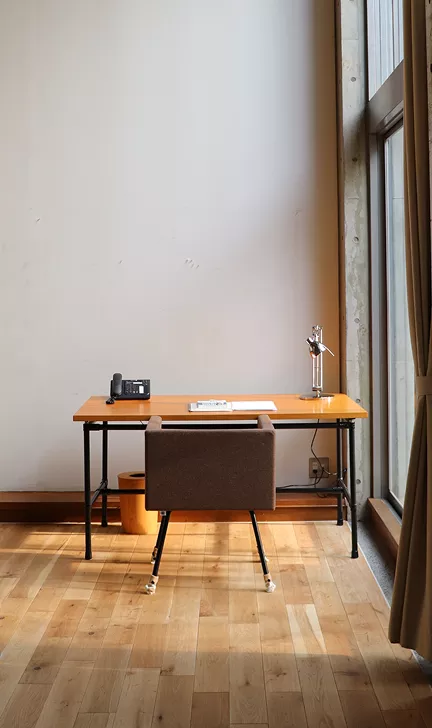
Work and living space, Communal spaces, Galerie Pierre Bergé / Salon, Auditorium, Library room
制限事項
Residents are invited to engage with artistic, cultural, academic and economic communities across the Japanese archipelago. They receive the support of an on-site team who assist them with their research and identify relevant contacts.